Your message has been sent. Thank you!
 Your message has been sent. Thank you!
I'm ready to book
Hmm, I still need more information
My information
Detailed information
From $ USD
Ho Chi Minh Trail Motorcycle Tour – 12 Days

Duration:
12 Days/ 11 Nites

Destinations:
Hanoi - Nha Trang

Tour Level:
More offroad (>40%)

Highlight:
Destination:
Ha Noi
Mai Chau
Tan Ky
Phong Nha
Ke Bang National park
Khe Sanh
Vinh Moc tunnels
Hue
Da Nang
Hoi An
Kon Tum
Buon Me Thuat
Lak Lake
Nha Trang
Pickup from:
Hanoi, Airport or any hotel in Ha Noi city
Suitable Bikes:
Honda XR150L, Honda CRF300L,






North Vietnam temperature can range from around 6°C on winter nights in Sapa to 34°C on summer afternoons in Hanoi, so the month you travel can shape the entire riding experience. Altitude matters just as much as the time of year, with mountain areas staying around 8 – 11°C cooler than the capital throughout the year. This guide gives monthly averages for each key area, explains how each season feels from the saddle and shows which months suit a motorbike trip best.
The table below compares North Vietnam temperature in January and in June – July for each area you are likely to ride through:
| Area | January | June – July | What to expect |
| Hanoi and the Red River Delta | 14 – 20°C | 26 – 34°C | Humid summers, mild and drizzly winters |
| Sapa and the Northwest mountains | 6 – 12°C | 18 – 23°C | Cool summers, fog and occasional frost in winter |
| Ha Giang and the far north | 9 – 16°C | 24 – 32°C | Crisp, clear autumns and wet roads in July – August |
| Ha Long, Hai Phong and the coast | 15 – 20°C | 26 – 33°C | Sea breezes, with typhoon season from July to October |
North Vietnam temperature is shaped more by altitude than by distance from the equator. Lowland Hanoi has hot, humid summers and relatively mild winters, while higher areas such as Sapa and Ha Giang remain cooler throughout the year and can become genuinely cold in winter.
Along the coast around Ha Long and Hai Phong, temperatures are fairly similar to Hanoi, although the sea helps soften the chill on winter nights. For riders, this means the weather can change noticeably within a single day, from comfortable shirt-sleeve temperatures in the delta to conditions that call for a fleece or windproof layer in the mountains.
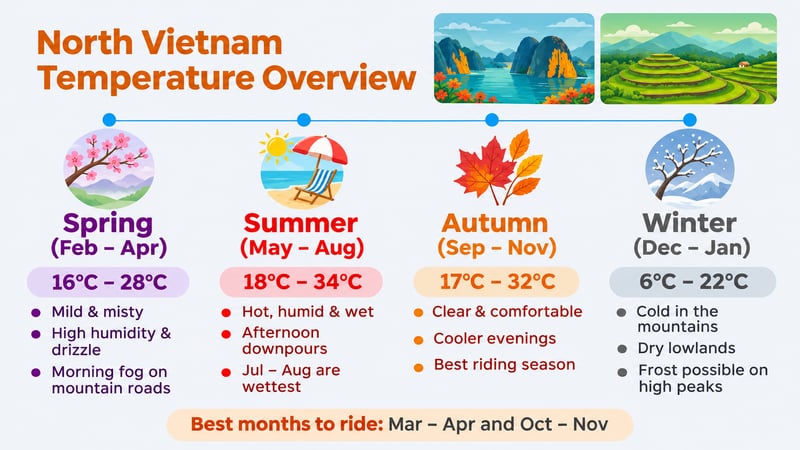
Hanoi and the surrounding Red River Delta experience four distinct subtropical seasons. January is usually cool and often drizzly, with temperatures of around 14 – 20°C, while June and July bring humid afternoons of 26 – 34°C.
The table below shows average lows and highs in Hanoi for each month of the year:
| Month | Average daily low–high (°C) | Average daily low–high (°F) |
| January | 14 – 20°C | 57 – 68°F |
| February | 16 – 22°C | 60 – 71°F |
| March | 18 – 24°C | 65 – 75°F |
| April | 22 – 28°C | 71 – 82°F |
| May | 24 – 32°C | 76 – 90°F |
| June | 26 – 34°C | 79 – 93°F |
| July | 26 – 34°C | 79 – 92°F |
| August | 26 – 33°C | 78 – 91°F |
| September | 25 – 32°C | 77 – 90°F |
| October | 22 – 30°C | 72 – 86°F |
| November | 19 – 26°C | 66 – 80°F |
| December | 15 – 22°C | 59 – 72°F |
Source: General monthly estimates compiled from Vietnamese meteorological reports in 2025.
Spring often catches visitors by surprise. In February and March, humidity can rise so high that walls and floors become damp, a spell locals call nồm. Light drizzle is also common, leaving city streets wet and sometimes slippery.
From May to August, the main challenge shifts from dampness to heat. Short but intense downpours often arrive in the afternoon, so setting out early in the morning is usually much more comfortable than beginning a ride after lunch.
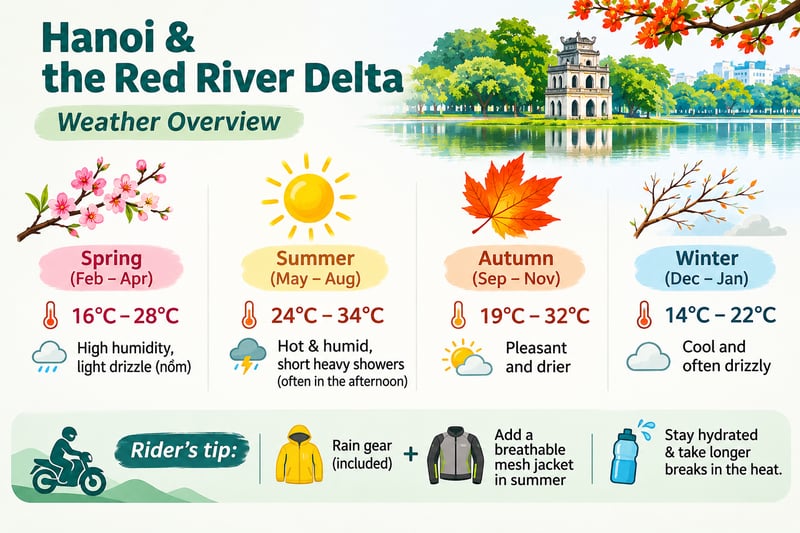
Rider’s tip: Rain jackets and trousers are included with every one of our tours, so for summer riding, you mainly need to add a breathable mesh jacket. Keep water within easy reach and allow for longer breaks during the hottest part of the day.
Sapa sits around 1,500 m above sea level and remains approximately 8 – 11°C cooler than Hanoi throughout the year. Winter nights can drop close to 6°C, while summer days stay pleasantly mild at around 18 – 23°C, making the area a welcome escape when the delta is at its hottest.
The table below shows average lows and highs in Sapa for each month of the year:
| Month | Average daily low–high (°C) | Average daily low–high (°F) |
| January | 6 – 12°C | 43 – 54°F |
| February | 8 – 14°C | 46 – 57°F |
| March | 11 – 18°C | 51 – 65°F |
| April | 14 – 21°C | 57 – 70°F |
| May | 16 – 22°C | 61 – 72°F |
| June | 18 – 23°C | 64 – 73°F |
| July | 18 – 23°C | 64 – 73°F |
| August | 17 – 23°C | 63 – 74°F |
| September | 16 – 22°C | 61 – 71°F |
| October | 14 – 19°C | 56 – 66°F |
| November | 10 – 16°C | 50 – 61°F |
| December | 7 – 13°C | 44 – 56°F |
Source: General monthly estimates compiled from Vietnamese meteorological reports in 2025.
On a motorbike, the cold can feel sharper than the temperature suggests. Wind exposure on high passes such as O Quy Ho increases heat loss, while rain or damp clothing can make riders feel colder, especially in winter.
From December to February, a thermal base layer, windproof outer layer and full-finger winter gloves become particularly important. Our guide to riding gear for Vietnam weather explains how to layer your clothing for different riding conditions.
If you are planning to include Fansipan, the highest peak in Indochina, our guide to the Hanoi to Fansipan distance can also help you work it into your route.
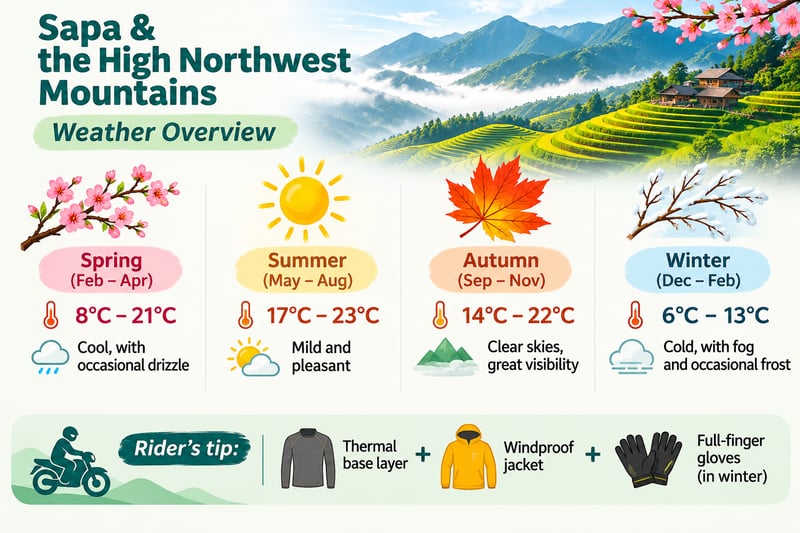
Rider’s tip: Check the forecast on the evening before crossing O Quy Ho in winter. Fog can reduce visibility quickly on the pass, so make sure your visor is clean and your headlight is working properly before you set off.
Ha Giang’s dramatic limestone landscape sees warm summers of around 24 – 32°C and crisp winter temperatures of 9 – 16°C in January. Higher areas around Dong Van and Ma Pi Leng can be colder still, so these figures should be treated as the warmer end of the conditions you may encounter.
The table below shows average daily lows and highs recorded for Ha Giang City. These figures represent the lower-elevation city area and should not be treated as representative of the higher Dong Van Plateau, where temperatures can be noticeably lower.
| Month | Average daily low–high (°C) | Average daily low–high (°F) |
| January | 9 – 16°C | 48 – 61°F |
| February | 11 – 18°C | 52 – 64°F |
| March | 14 – 21°C | 57 – 70°F |
| April | 18 – 26°C | 64 – 79°F |
| May | 21 – 30°C | 70 – 86°F |
| June | 24 – 32°C | 75 – 90°F |
| July | 24 – 32°C | 75 – 90°F |
| August | 24 – 32°C | 75 – 90°F |
| September | 22 – 31°C | 72 – 88°F |
| October | 19 – 28°C | 66 – 82°F |
| November | 15 – 24°C | 59 – 75°F |
| December | 11 – 20°C | 52 – 68°F |
Source: General monthly estimates compiled from Vietnamese meteorological reports in 2025.
Autumn, from September to November, is the season many riders look forward to most. Rain begins to ease, the skies become clearer and the air turns pleasantly crisp, creating excellent visibility from viewpoints such as Ma Pi Leng Pass.
July and August feel very different. Heavy summer rain can wash water, mud and loose stones onto mountain roads, while conditions on the high passes can change quickly.
On our Ha Giang motorbike tours, a mechanic travels with every group to help deal with mechanical issues along the way. Riders who want additional support when weather conditions become difficult can also add a support vehicle for 150 USD per day.
Ha Giang combines cool highlands with rapidly changing mountain weather.
Rider’s tip: Dress in layers that are easy to remove during a roadside stop. A chilly morning on the plateau can become surprisingly warm once you descend into the valleys around lunchtime.
Temperatures along the northern coast stay fairly close to those in Hanoi, with January averaging around 15 – 20°C and June reaching 26 – 33°C. Winter nights are usually slightly milder than in the capital because the sea retains heat.
The table below uses Hai Phong temperature data as a reference for the northern coastal area around Ha Long Bay. As conditions can vary between Hai Phong and Ha Long, particularly with local coastal exposure, these figures should be treated as a regional reference rather than exact temperatures for Ha Long.
| Month | Average daily low–high (°C) | Average daily low–high (°F) |
| January | 15 – 20°C | 58 – 68°F |
| February | 16 – 21°C | 61 – 70°F |
| March | 18 – 23°C | 65 – 73°F |
| April | 22 – 27°C | 71 – 81°F |
| May | 25 – 31°C | 76 – 88°F |
| June | 26 – 33°C | 79 – 91°F |
| July | 26 – 32°C | 79 – 90°F |
| August | 26 – 32°C | 78 – 89°F |
| September | 25 – 31°C | 76 – 88°F |
| October | 23 – 29°C | 73 – 85°F |
| November | 19 – 26°C | 67 – 80°F |
| December | 16 – 22°C | 60 – 72°F |
Source: General monthly estimates compiled from Vietnamese meteorological reports in 2025.
Sea breezes can make the summer heat feel more manageable, but the coast is also the first part of northern Vietnam to feel the impact of major storms. Typhoon season peaks from July to October and can bring strong winds and prolonged heavy rain.
Spring and autumn are generally the most comfortable times for a coastal ride, when temperatures are milder and sea conditions tend to be calmer.
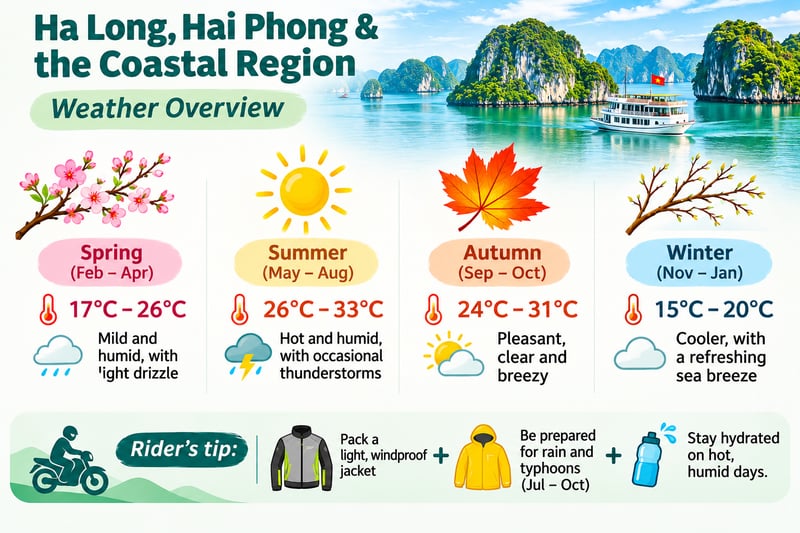
Good to know: Check storm warnings before any coastal ride between July and October. It is also worth keeping a spare day in your itinerary in case bad weather affects or cancels a boat trip on the bay.
Monthly North Vietnam temperature figures tell you how warm or cool the air may be, but the seasons give a better sense of what the journey will actually feel like. Northern Vietnam has four distinct seasons, each bringing its own scenery, road conditions and packing requirements.
Spring gradually warms Hanoi from around 16 – 22°C in February to 22 – 28°C in April, while Sapa ranges from approximately 8°C to 21°C. February and March are often grey and humid, with light drizzle and morning mist frequently covering mountain roads.
The reward comes in the landscape. Tết, the Lunar New Year, falls in late January or February, when plum and peach blossoms brighten the northern mountains. By April, the drizzle begins to ease and clearer skies become more common.

What to pack: A windproof jacket, waterproof shoes and a clear helmet visor for damp or misty mornings.
Summer is both the hottest and wettest season in northern Vietnam. In Hanoi, average daily temperatures range from around 26°C at the low end to 34°C at the high end during the peak summer months. Heat waves can push daytime temperatures to 37 – 38°C. Sapa, by comparison, remains much cooler, with average daily temperatures of around 18 – 23°C.
Short, intense downpours commonly develop in the afternoon, with July and August among the wettest months. Heavy rainfall also increases the risk of landslides on mountain roads, although the higher ground around Sapa and Ha Giang still provides a cooler escape from the heat of the delta.

What to pack: UV-protective clothing, breathable gloves, sunglasses and sunscreen. Starting early also helps you avoid riding through the strongest midday heat.
Autumn is the season many riders wait for. Hanoi gradually cools from around 25 – 32°C in September to 19 – 26°C in November. In Sapa, at around 1,500 m above sea level, September temperatures average about 16 – 22°C, making the highlands noticeably cooler than the lowlands.
Rainfall eases, skies become clearer and evenings turn cooler, giving riders some of the best visibility of the year across the high mountain passes. Rice terraces in Mu Cang Chai and Hoang Su Phi turn golden from around mid-September to early October.
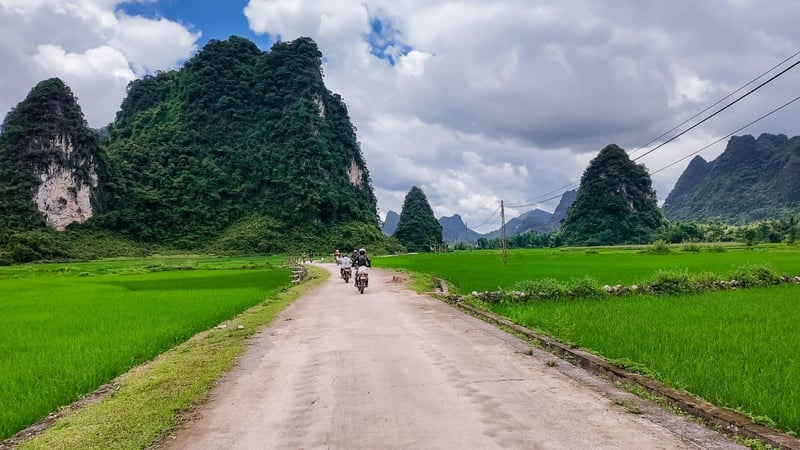
What to pack: A light jacket, riding boots, anti-slip gloves and waterproof bags for your phone and camera.
Winter is generally dry across the lowlands but can feel genuinely cold in the mountains. Hanoi stays around 14 – 22°C, while Sapa drops to approximately 6 – 13°C. On higher ground, nighttime temperatures can fall close to 0°C.
Cold spells moving down from the north can lower temperatures by several degrees overnight, while low cloud often hides the mountain peaks. Frost and, in rare years, snow may appear around Fansipan and Sapa.

What to pack: A thick jacket, thermal layers, a neck warmer, full-finger gloves and high-ankle boots.
If you remember only one thing about North Vietnam temperature, make it this: March – April and October – November offer the best overall conditions for riding. Hanoi averages roughly 18 – 30°C during these periods, rainfall is relatively light and mountain passes are usually clearer.
Early March can still bring mist to higher areas, so if your dates are flexible, late March and April often provide better visibility. Our northern tours are busiest from late August to December and again after the Lunar New Year, when conditions tend to be cool, dry and clear.
The best month for your trip, however, still depends on what you want to experience:

Whichever month you choose, every tour includes a Honda XR150L, CRF250L or CRF300L, along with a helmet, gloves, knee and elbow pads, and rain gear. That means you mainly need to pack the warm layers suited to the coldest part of your route.
Our North Vietnam travel guide helps you turn the right month into a full route. For a longer trip, a Vietnam motorbike ride tour covers more of the country, and our Northern Vietnam motorbike tours let you ride the north in its best season.
January. Hanoi averages 14 – 20°C and Sapa 6 – 12°C, and nights on high ground can fall close to 0°C during cold spells.
Yes. Hanoi averages up to 34°C in June and July, and high humidity makes it feel hotter. The mountains stay far cooler, at around 18 – 23°C in Sapa.
Yes. December is usually dry and clear, which suits Hanoi and Ha Long. The mountains turn cold, so pack thermal layers and winter gloves for any ride above the delta.
Rarely. Snow falls in Sapa only during strong cold spells between late December and February.
Yes. Frost covered the Fansipan summit at -3°C in January 2026, and Sapa holds a record low of -6.1°C from January 1974. Mau Son in the northeast has also reached -5°C.
Colder than the forecast. At around 60 km/h, wind chill makes 10°C air feel closer to 5°C, and high passes and rain add to the chill. Dress for the “feels like” temperature, not the number on your phone.
North Vietnam temperature can change just as much with altitude as it does with the month, ranging from humid 34°C afternoons in Hanoi to frosty nights in the mountains above Sapa. Choose your travel month first, then pack for the coldest part of your planned route.
Tell us your travel dates through our contact page or on WhatsApp at +84 979 884 588, and we will suggest the right route and gear for the season.

LET'S RIDE WITH US
 Duration:
4 Days/ 3 Nites
Destinations:
Hanoi - Vu Linh - Phu Yen - Moc Chau - Mai Chau - Hanoi.
Tour Level:
Chill Level Tours
 Duration:
6 Days/ 5 Nites
Destinations:
Hanoi - Dong Van
Tour Level:
Chill Level Tours
 Duration:
4 Days/3 Nites
Destinations:
Hanoi - Thac Ba lake
Tour Level:
Chill Level Tours
 Duration:
7 Days / 6 Nites
Destinations:
Hanoi - Hanoi
Tour Level:
Chill Level Tours
 Duration:
12 Days/ 11 Nites
Destinations:
Hanoi - Nha Trang
Tour Level:
Chill Level Tours
 Duration:
11 Days/10 Nights
Destinations:
Hanoi - Thac Ba lake
Tour Level:
Chill Level Tours
 Duration:
11 Days/ 10 Nights
Destinations:
Hoi An - Saigon
Tour Level:
Chill Level Tours
 Duration:
8 Days/ 7 Nites
Destinations:
Hanoi - Ha Giang
Tour Level:
Chill Level Tours
4-Day Northern Vietnam Motorbike Tour From Hanoi
 Duration:
4 Days/ 3 Nites
 Tour Level:
Chill Level Tours - Moderate Level Tours
Experience the authentic Vietnam
Ride off the beaten track
Visit beautiful Thac Ba Lake
Interact with lovely local people
Riding some scenic offroad tracks
Enjoy a variety of local foods
6-Day Amazing Motorbike Tour To Ha Giang
Duration:
6 Days/ 5 Nites
Tour Level:
Challenging Level Tours - Moderate Level Tours
Experience the authentic Vietnam
Ride off the beaten track
Discover the hidden gem of Ha Giang
Ride scenic single tracks
Interact with lovely local people
Explore a variety of the local traditions
4-Day Special Offroad Motorbike Tour Vietnam
Duration:
4 Days/3 Nites
Tour Level:
Challenging Level Tours - Moderate Level Tours
Interact with lovely local people
Fun & Scenic offroad
Swimming at the largest lake in Nam
Ride off the beaten track
Special experience at the homestay
Experience the authentic Vietnam
7-Day Motorcycle Tour Halong and Northeast
Duration:
7 Days / 6 Nites
Tour Level:
Chill Level Tours
Experience authentic Vietnam
Ride off the beaten path
Interact with lovely local people
Explore world heritage Ha Long Bay
Visit Cao Bang & Ban Gioc Waterfall
Enjoy scenic offroad trails
12-Day Ho Chi Minh Trail Motorcycle Tour
Duration:
12 Days/ 11 Nites
Tour Level:
Chill Level Tours - Moderate Level Tours
Experience the authentic Vietnam
Ride off the beaten track
Ride some beautiful coastlines
Interact with lovely local people
Enjoy a variety of local foods
Visit special historical sites
11-Day Grand Laos – Vietnam Motorbike Tour
Duration:
11 Days/10 Nights
Tour Level:
Challenging Level Tours - Moderate Level Tours
See the real Vietnam & Laos
Experience the authentic culture
Interact with lovely local people
Ride off the beaten track
Discover unreal landscapes
Enjoy Viet & Lao cuisine
11-Day Motorbike Tour Hoi An – Saigon
Duration:
11 Days/ 10 Nights
Tour Level:
Experience authentic Vietnam
Enjoy a variety of Vietnamese food
Ride off the beaten path
Interact with lovely local people
Visit the "Must-See" in central Vietnam
Explore the Ho Chi Minh road
8-Day Motorbike Tour Around Northern Vietnam
Duration:
8 Days/ 7 Nites
Tour Level:
Challenging Level Tours - Moderate Level Tours
Experience authentic Vietnam
Interact with lovely local people
Enjoy scenic off-road trails
Ride off the beaten path
Visit all the "Must-See" in North Vietnam
Explore Sapa & Ha Giang Loop